Landscape Photography In The Age of Uncertainty - A Very Brief Essay
A Historical Shift in Visual Control
Landscape photography—the depiction of nature—is as old as photography itself. Originally, photographers often (not always) sought out the picturesque. Documentary approaches developed in the wake of industrialisation and, later, World War I. Suddenly, landscape photography could be a commentary on the resulting developments that affected work, life, social structures and the way, in which we interact with nature.
Post World War II landscape photography refocused on the idealised, the romantic and the picturesque in a colourful, happy and optimistic way. A new element was the desirable, aided by the increasing affordability of foreign travel.
Up until then, photography exerted visual control to show quintessential harmony, where nature was in what we perceive(d) to be its ideal state.
This idyll, however, is at odds with reality. From around the early 1980s, nature began to be portrayed as the fragile, embattled space that it had become through the irrepressible human desire to treat nature as a resource to be dominated and exploited, rather than something that needed protecting. The accepted began to be questioned.
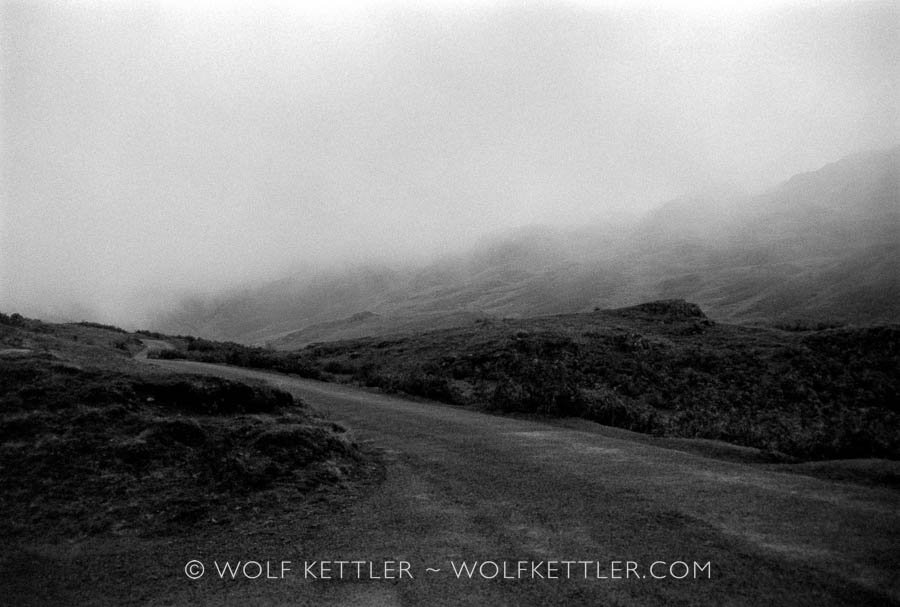
Hardknott Pass, The Lake District, October 1990
This photograph, conceived on film, is one of my favourite landscape photographs. On the surface, it shows an atmospheric, rugged landscape. The hilltops are shrouded in low clouds, the location is remote. And yet, if we look closely, we notice that a wound has been carved into the landscape. The wound has grown a scar in the form of a road.
The Sentimental Illusion of the Digital Idyll
Since the advent of social media with its 'influencers', landscape photography has retreated into the territory of the romanticised, idealised and the sentimental once more. Tourists again seek out picturesque locations according to a set of often questionable requirements. Promoting idyllic locations requires romanticised drama to create a sense of the unattainable and therefore enviable desirability in a flood of garish, over-processed and unimaginably happy images. The concept of visual control has returned. We can question the motives - perceived admiration from strangers (worship me because my life is happier than yours) and individual financial gain, whatever the greater cost.
Even in my own lifetime, the space that we allow nature to occupy, the space, where biodiversity happens, has reduced dramatically. According to the World Wildlife Fund‘s (WWF) Living Planet Report 2024, there has been a 73% decline in the average size of monitored wildlife populations in just 50 years (1970-2020). Habitat loss and degradation and overharvesting, driven primarily by our global food system, are the dominant threats to wildlife populations around the world.
Tropical rain forests are being cut down for timber and to make space for farming (the organised mass slaughter of animals) and palm oil production. Overtourism blights and ultimately destroys the most beautiful places on earth and makes life for residents unaffordable. Closer to home, what we think of as landscapes are spaces increasingly cluttered with buildings, new airport runways, out of town shopping centres, distribution facilities, data centres, roads, car parks and an onslaught of visitors looking for attractions and sublime nature. Soon, millions more electricity pylons will blight the last 'areas of outstanding natural beauty' if the Governments of the day have their way. It is cheaper to hate nature than to invent more harmonious solutions.
In the quest for ever greater convenience, economic growth and financial prosperity, we hope to rely on ‘soon to be rolled out’ technology to enable us to carry on 'as before’, when we should be making adjustments to the way in which we consume, work and live.
Documenting Loss in a Changing World
In our age of uncertainty—political (the rise of right-extremist populism and demise of democracy), geopolitical (the decay of established relationships) and climate breakdown—landscape photography has the duty to document what will invariably be lost within, I fear, less than a generation.
What we believe to be substantial is, in fact, intangible. My landscape photography has personal meaning. It documents the ordinary that is on my doorstep or that I discover in familiar places. In creating these photographs I aim to capture how my surroundings influence me and how my mind influences how I see them.
I do want to portray the beauty that still exists in landscapes. I believe it is important. And yet, my landscapes aim to expose, often subtly, the evidence of human intervention that we can no longer escape. Every photograph is a precious document of what will inescapably change.
View the 'Landscape Photography in the Age of Uncertainty' Gallery